
TeleRead posted a 3,000-word tribute to the late Chris Meadows—a hyper-talented veteran writer here—with the cooperation of his family. But you can also read their words directly. Below are memories from Chris’s father, Mark, his mother, Judy, his twin brothers Aaron and Alex, his Aunt Rebecca, and a family friend, Judy Condit Fagan.
Communion meditation
October 18, 2020 Virtual Service
Our Son Chris
By Mark D. Meadows
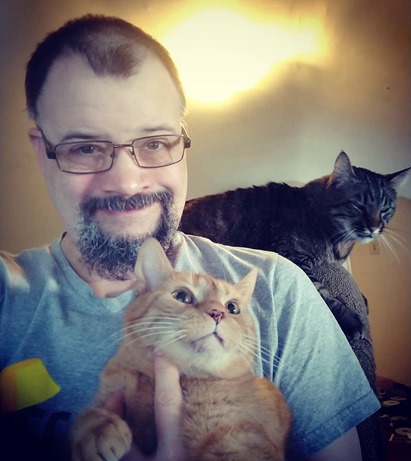
As all of you know, Judy and I lost our son Chris this week. He was only forty-seven. All I could think of this week was Chris, so I’m going to talk about him now.
Chris was an exceptional child. He taught himself to read at age two and was reading at sixth grade level by age four. He was soon reading every book in sight, and remembering what he read. We didn’t need an encyclopedia when Chris was at home. We could just ask him about anything.
Chris was always accident prone and suffered many breaks and bruises in his life. Even when he was a kid, bad luck seemed to plague him. One little example that was a family joke is that if we accidentally left a piece of eggshell in the scrambled eggs, it was a foregone conclusion that Chris would get it in his portion.
Another thing that brought our family mirth was Chris’s ability to type. His large motor skills were not great; if I tossed Chris a ball there was no way he could catch it. But put Chris at a keyboard and he typed like a maniac! For one job interview Chris had to take a typing test. After his test, he asked, “What’s my score?” The test person said, “We don’t know. We can only score up to 100 words a minute.”
I mentioned Chris being accident prone and not having a lot of good fortune. He owned five cars in his lifetime and wrecked four of them. He wrecked bicycles and motor scooters. He had a brilliant mind and two college degrees, and yet most of his jobs were hack-work jobs with no benefits, jobs that did not use his talents. And all he could afford were crummy apartments.
Chris’s life up to 2013 sometimes of reminded us of Job and how his life was filled with hardships and disappointments. But Chris also had the patience of Job.
His father, Mark
Chris’s life up to 2013 sometimes of reminded us of Job and how his life was filled with hardships and disappointments. But Chris also had the patience of Job.
No matter what Chris suffered, I never once heard him complain. I once asked him why, and he said, “I didn’t think it would do any good.” Chris was always optimistic and buoyant. He had a wonderfully keen sense of humor and always saw the best in everyone he encountered.
In 2013 Chris moved to Indianapolis and his life improved dramatically. His brothers live there and were eager to assist Chris. They helped him any way they could and made it possible for Chris to have a wonderful brownstone to live in—the nicest place he ever inhabited. Chris finally got a job he loved, one with good benefits. His boss constantly told Chris that he was their best employee and even used recordings of Chris to train new employees in how to do the job right.
Thinking of Chris’s earlier hardships, I am using three verses from the Book of Job for my devotion today.
=o=o=o=o=o=
Everyone’s life seems hard and short and cruel at times. Job 14:1-2 says, “Man that is born of a woman is of few days and full of trouble. He cometh forth like a flower, and is cut down: he fleeth also as a shadow, and continueth not.”
Job is right. We have very few days in this troubled world, but he is not quite right when he says that we continueth not. The human soul is indestructible. It will live forever either in heaven or hell, and we are put in this difficult world to decide which.
Job is the oldest book in the Bible, but even at this extremely early time in history, Job realized that sinful man cannot make it on his own. We cannot lift ourselves into heaven by ourselves. Job did not have any scriptures to study, since he was the first to write a book of the Bible. In our information age today, there is no excuse for anyone to reject Jesus Christ out of ignorance, and yet millions do. Almost everyone who does not believe in the Bible has never even read it, has never read any commentaries, and does not know it is subject to objective proof.
But Job knew the answer that can save us. Job says, “I know that my redeemer lives, and that in the end he will stand upon the earth. And after my skin has been destroyed, yet in my flesh I will see God; I myself will see him with my own eyes—I and not another. How my heart yearns within me!” (Job 19:25-27)
Job was right. His redeemer DOES live, and He is OUR redeemer too. He does live and He did stand upon the earth and He will do so again. The reason He came to stand upon the earth the first time was to die on the cross to shed His blood to redeem us from our sins. He lives, and because He lives, we will live. He was raised from the dead, the first sheaf of the harvest, and because the first sheaf was raised to a glorious harvest, so can we lesser sheaves join Him as we are harvested.
“Because Jesus Christ came and gave his life for us, we can and we must say with Job, Though He slay me, yet will I trust in Him.” (Job 13:15)
Judy Meadows (and Mark): “You’re dealing with a family of writers.”
When Alex gave this obituary, which Mark wrote, to the funeral home in Indianapolis, the lady read it and exclaimed, “My goodness! This is so well written!” Alex told her, “You’re dealing with a family of writers.” Alex and Mark knew how Chris would laugh about that little encounter.
Christopher Edward “Chris” Meadows, 47, of Indianapolis, Indiana, died October 14 after being struck by a hit-and-run driver as he rode his bicycle. Chris was born on March 9, 1973, in Kansas City, Kansas, the son of Mark and Judy Meadows of Cassville, Missouri. He graduated from Cassville High School in 1991 as a National Merit Scholar and attended Missouri State University in Springfield, receiving a B.S. in Mass Media in 1996 and a B.S. in Computer Information Systems in 2001.
Chris was an expert writer and wrote countless freelance articles. He had a large presence on the Internet, writing, editing, interviewing, and maintaining blogs. He was an internationally recognized authority on e-book readers and e-publishing. Chris was loved and respected by a wide following across the country and around the world.
Most of Chris’s employment involved providing support and customer service relating to computers and other technical areas. He had the uncommon ability to explain the most inscrutable and complicated technological applications in simple terms that anyone could understand. Chris was unflappable in helping customers from timid to irate. His coworkers remember his trademark greeting when answering the telephone, “This is Chris. How can I make your day better?” At the time of his death, Chris was employed by Anthem Blue Cross Blue Shield Insurance in Indianapolis.
Chris is survived by his parents and by his two brothers and their families: Aaron and Karen Meadows of Indianapolis and Alexander and Rachael Meadows of Greenwood, Indiana. He is also survived by sister-in-law Jennifer and Tom Mellen of Indianapolis and by eleven nieces and nephews. Chris was preceded in death by his grandparents, Lester and Lorene Meadows of Jenkins, Missouri, and Robert and Jewell Carter of Columbia, Missouri.
Chris will be available for visitation Wednesday, October 21, 2020, from 4:00 to 8:00 p.m at Daniel F. O’Riley Funeral Home in Indianapolis. Afterward, Chris will return home for interment in a family section of Maple Park Cemetery in Aurora, Missouri.
Friends may view Chris and sign a guest book at Peterson Funeral home on Friday, October 23 or Saturday morning, October 24.
A graveside service will be held on Saturday, October 24, at 1:00 in the afternoon under direction of Peterson Funeral Home with Pastor David Martin of Elm Branch Christian Church officiating.
More from Judy: “It was certainly in Chris’s genes to read!”
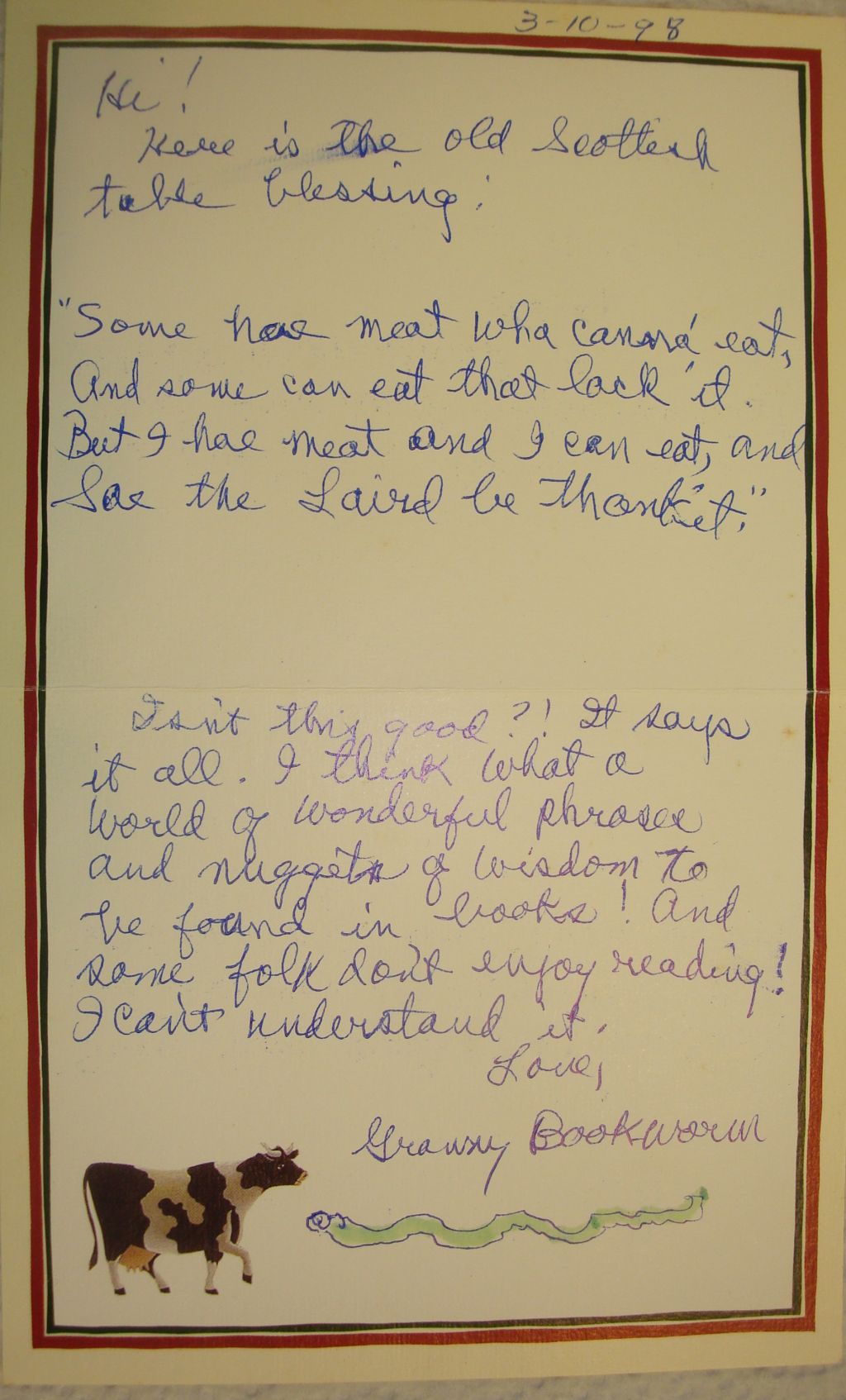
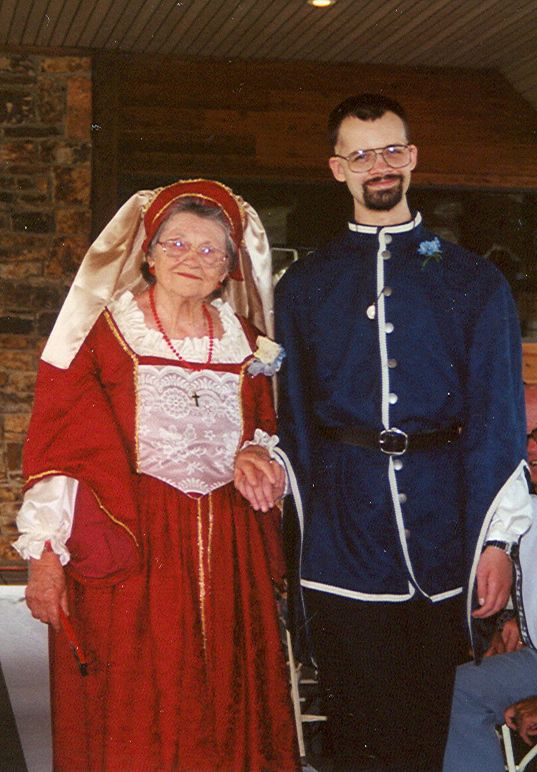
Chris’s grandmother, Lorene Meadows was an avid reader. When she was four, her mother begged the library in Aurora to give her a library card since she could already read. At the time, she was the youngest person issued a card there, as the required age was six. Granny died in November 2014, two month short of her 100th birthday. Mark recently unearthed this little note card she sent in 1998. We credit Granny with being the reason for all her kids, grandkids, and great-grandkids being avid readers. It was certainly in Chris’s genes to read! This picture of Granny & Chris was taken at a renaissance wedding.
Aaron: “He loved us equally and always.”
Chris was always oblivious in the most charming of ways. He never could tell the difference between me and Alex because there was no difference between us to him, he loved us equally and always. That obliviousness extended into his work. He was oblivious to the level of anger or frustration his customers were experiencing, allowing him to give the same careful and thoughtful care to everyone, something that made him a stellar employee. He was also oblivious to any sort of personal discrimination against others. He would talk to anyone, anywhere, about most anything.
When Chris was still living in Springfield, MO, and I was living in St. Charles, MO, there were a few years where I was driving to Springfield and working 30 hours every other weekend. When I’d go down, I’d often pick up Chris on Sunday afternoon and take him to lunch. He always had an interesting, out-of-the-way place he wanted to go to, and several recommendations of dishes to try. They were often little mom-and-pop shops, for which said mom and pop would often greet him as he entered the door. It wasn’t usually a place where I would have considered eating, or even been aware of, but it was usually quite good, or at least quite interesting.
The final time I visited with Chris was when he came to visit the Sunday before his accident. I had just had a minor outpatient operation and was ambling around the house or the weekend. Chris showed up with a collection of card games and a will to play them. We sat at the table and played several games; one among them was a Robotech Card game he had just gotten and hadn’t had an opportunity to play yet. It definitely reminded me of the many Saturday mornings spent watching the series, and the many memories since through which wove the theme of Robotech which became Chris’s sobriquet. We had a good time, and he set in the afternoon on his bike, intent on doing some grocery shopping before heading home.
Alex: “When he wasn’t reading, he was writing.”
Growing up, Chris was frequently the odd man out, though it didn’t seem like it bothered him very much. As a child, he spent much of his time reading, writing, listening to music, and recording his own playlists onto cassette tape. Chris read at a blazing pace. Even in middle school, he would check out stacks of books from the library each week. In the summer, he would read an entire novel between breakfast and lunch and another before dinner. He particularly enjoyed spy novels, space novels, and fantasy novels. And when he wasn’t reading, he was writing. In the corner of his room was a stack of spiral bound notebooks, filled in the cramped, jagged, and left-leaning scrawl of his southpaw penmanship. As his palm trailed his creativity in left-to-right motion, his hand had a constant silvery smudge of graphite where the edge of his palm slid across the page of text. He rarely shared his stories, but wrote them because they needed to be written. He always favored the style of beginning the story in the middle. Usually with a monologue or conversation between two characters. His stories frequently built upon some trope or genre or show that he was interested in at the time, and ranged from stories of life in outer space, to paramilitary GI-Joe inspired dramas, to a young boy named Chris.
This was perhaps my favorite story series he wrote, and one which he shared with us. In the story, Chris had an obnoxious pair of twin brothers who had mercilessly soaked him with their new super soakers. As he fled dripping wet, he ran into the discarded and fully automated manufacturing facility of his Richie-rich-like parents. With some quick design work and manufacturing systems reconfiguration, he produced a backpack-mounted arrangement with a large water reserve and pressurized tanks, then went to find his brothers. With the twin backpack-fed water blasters, he revisited his humiliation upon them ten-fold. For the record, I do not recall ever squirting Chris with a supersoaker and certainly never drenching him. For the next several weeks, we spent a lot of time imagining what other water-related products our alter-egos might produce in the increasing quest for aqua supremacy. We three boys discussed the different water balloon launchers, and water mines, and different sorts of water gun solutions. We drew pictures and described battles, and Chris wrote a few more stories with our inputs.
I think Chris really keyed in on “the story” in most things he did. When he was young, he always wanted to be a disc jockey (DJ) and would produce his radio show, direct to cassette tape. He always played the part of a DJ persona and he dubbed in music tracks and interviews with mom and dad interspersed with DJ commentary. I remember he once wrote a radio play and assigned roles to the family members and hounded them for days until we each agreed to record our part of the script. I don’t recall what the topic was, now, although I bet he still has the recording. When we started playing role-playing games such as Dungeons and Dragons, Robotech, Teenage Mutant Ninja Turtles, and Rifts, Chris was frequently the referee or dungeon master. He always wrote a lengthy and complicated plot, with many different characters and each with their own motivations and foibles. One summer, we started playing a dungeons and dragons game. True to form, his story began in the middle and we were already in some ancient dungeon, fighting monsters and reclaiming treasure. In our first session, we completed that dungeon crawl and returned to the vast city that he had prepared for us. We never left the city again. There was too much to do at that point, too much to explore, and too much to expand together. We spent the next several weeks drawing out the city on quarter inch graph paper and taking Chris’s story hooks and expanding them. That creation process was so much fun. For that game, I created a mystical wizard and named him Mourtegoul—the name I still use to this day for online games and my email. I enjoyed that character so much. One of those summer days a scant week before my birthday, we returned to the kitchen for lunch and seeing my parents, I exclaimed to them, “I know what you can get me for my birthday—the ability to do magic!” Unbeknownst to me, my parents (somewhat dumbfounded looking by that point) had already purchased and wrapped for me a manual to stage magic. I still have and love that magic book and think of that summer when I see it.
Chris didn’t often engage in the traditional sport of boys on the farm, preferring a quiet afternoon with a book to traipsing through the forest in search of imaginary foes. He loved to play board games, and watch cartoons. We three would get up early on Saturdays to catch back-to-back episodes of Harmony Gold’s Robotech cartoon series at 7 a.m.
alex
Chris didn’t often engage in the traditional sport of boys on the farm, preferring a quiet afternoon with a book to traipsing through the forest in search of imaginary foes. He loved to play board games, and watch cartoons. We three would get up early on Saturdays to catch back-to-back episodes of Harmony Gold’s Robotech cartoon series at 7 a.m. That show and its spin offs were a mainstay in our childhood play. We watched the show, we had the toys, we found the role playing game at some point, and we bought all 18 of the novels written after and beyond the shows. Years later, we all collected the original 84 episodes on DVD or blu ray, we played numerous robotech video games, and we even got to see a feature length film released in theaters. Chris used the handle Robotech_Master in most of his online communities as a result.
Chris enjoyed movies quite a bit. His first undergraduate degree was in broadcast media. He especially enjoyed Hong Kong films with Jackie Chan, Chow Yun Fat, and Samo Hung. He loved anime of all sorts, especially those which were used for the original Robotech series and those which spun off of it. He loved Hayao Miyazaki films. I think his favorite movie was Lupin III: Castle of Cagliostro—a charming Japanese anime with a clever and somewhat zany master criminal and his varied companions. He didn’t just love these films, though—he loved the story around the films themselves. He knew arcane connections between certain animes, and certain blockbuster films, and between different movie studios, and producers. He recalled perfectly a litany of facts about the entire James Bond franchise and would point these sorts of things out to anyone he watched with. He would frequently watch movies together with his online friends, sort of his own mystery science theater.
Chris interacted through his computer to the world. As a result, he typed more than 120 wpm, after corrections (of which there were virtually none.) He used his typing and writing skills extensively in his work life. I recall he worked briefly for O’Reilly automotive, typing up corrections to their manuals and creating new text content. At one point, the company wanted to evaluate their tech writers and so they hired an outside firm to provide some analysis. The firm had all the writers type and correct a document. The document had numerous spelling and grammatical errors, and the test was timed. The expectation was that each writer would complete some portion of the test and they could rank their abilities based on how much they completed in the allotted time and how many of the errors they corrected. At the end, the firm admitted they couldn’t really assign Chris an accurate score. He had completed not a portion, but the entire document in the given time, and had found and corrected every mistake of grammar and spelling. They confessed they had never had anyone approach either, let alone both at once. Chris preferred a good mechanical switch keyboard and had many vintages from the 80s to now. When Chirs was on the computer, it frequently sounded like a battlefield, with intermittent silence and bursts of machine gun-like typing.
Chris’s second bachelor’s degree was in Computer Information Systems. This was a powerful augmentation to his typing and knowledge abilities. Through this degree, he found several of his callings in life–providing unparalleled technical support, and a true love of technologies. Chris started providing phone support for a telecommunications company (MCI) and later for a local internet service provider. Chris had an uncanny knack for talking people through complex procedures. His patience was absolutely infinite and he was completely unflappable in dealing with customers. Part of his Asperger’s Syndrome symptoms was a nearly complete inability to register emotion in someone’s voice. This seeming limitation was an absolute superpower for phone support. The most upset and irate customer was met with absolute professionalism and complete calm. At which point, Chris could deliver a complete walkthrough on any process needed for any product required. He had found his calling. Through the years, he provided phone support for Best Buy (on the next tier team beyond the well-known Geek Squad) and finally for Aetna’s Blue Cross Blue Shield insurance products. Chris provided phone support to doctors and nurses on policies and products. He was frequently praised by peers and managers, and recognized by vice presidents in the company for his flawless service.
Whenever Chris came to visit, he always had a few bags with him. Backpacks, fanny packs, and totes. When he arrived at a new destination, he would begin by unpacking his arsenal of tablets, phones, and ebook readers and establishing his command center.
alex
Chris loved technology. From the half dozen computers in his apartment, to the electric bicycle that he rode all over, to the scores of tablets and ebook readers he owned. Whenever Chris came to visit, he always had a few bags with him. Backpacks, fanny packs, and totes. When he arrived at a new destination, he would begin by unpacking his arsenal of tablets, phones, and ebook readers and establishing his command center. He had stands, and keyboards, battery packs and charging cables. And he always had something to do on them. I’m not sure what he was doing most of the time. Writing, researching, chatting with friends, and who knows what else. I do know that he enjoyed using his computer by proxy through one of his tablets. One day, he came to visit and one of my best friends was coming to visit as well. This was the first time Kevin would meet Chris after hearing stories about him for 5 years. Kevin and I had met in Chicago but had not lived in the same state again until he moved to Indiana. Kevin, an Egyptologist and university history department chair, was excited to meet Chris and this was his chance. Kevin and I loved to rib and prank each other, and today was no different. When Chris arrived, he immediately began unpacking his kit, laying out device after device. As Kevin came up to him, I intercepted and made the introduction: “Chris, this is my friend Kevin—he thinks ebooks are passee.” And then I vanished. The scholarly Kevin was completely speechless and couldn’t get a word in as Chris calmly laid into him with a history of ebooks and ebook readers and a thesis on the merits of various systems of text portability and product delivery. It was more than five minutes before Kevin could break in and apologize and extricate himself.
Chris loved video games. He played many different kinds. His favorite was City of Heroes—a massively multiplayer online role playing game where players take on the persona of a superhero and fight crime in a futuristic metropolis. Chris always played anthropomorphic humanoid cats. The last time I saw Chris before the accident, he rode down to my house for the afternoon and introduced me to a new game he was enjoying called “Hardspace: Shipbreaker.” He methodically walked me through a couple levels of it and advised me on the best approach to take in considering how to clear each level. In that game, you play as a space salvage yard specialist tasked with cutting down spaceships and salvaging their systems. It is a sort of 3-dimensional puzzle game, wrapped in an interesting story.
When I think about all these different memories of my oldest brother, I see a few threads in them. Chris was always captivated by the story whether it was one that he was telling, or one that he was receiving, or one that he created in his technical support conversations with customers. Chris was empowered by the technology–it expanded his world, it created his most meaningful interactions through the internet, and it gave him something to share with his friends and family and with strangers. And Chris inspired the creativity in others. His stories galvanized us to create maps and sub stories and visions. His tech support removed roadblocks and created new opportunities. His online presence started communities. His advice created new franchises in ebooks.
In his life, Chris frequently seemed like the odd man out, and yet that never stopped him from being the new guy in the group. He didn’t feel social pressures like so many of us, if he wanted to talk to someone, he did. If he had an opinion that fit the discussion, he gave it. And it was always delivered with professionalism and calm, at 120 wpm with perfect grammar and spelling.
Rebecca Meadows, Chris’s aunt: “I told him I loved him… I will always cherish that.”
As Chris’ aunt by marriage, I have two memories I’d like to share.
When his Uncle Denis, and I were getting married we were all waiting, visiting among several of us, in the church library until time to start the wedding. Out of nowhere a 16 year old Chris, said in a loud voice, “Excuse me, this is a library and there should be quiet! I’d like to read this book!” in a very exasperated voice. He had picked up a book in the church library and started reading. Later, when we go our wedding pictures back, there was Chris with his head in that book during our wedding ceremony! We got a big kick out of that!
The other memory is much more recent. A few weeks ago, he called me out of the blue. He said, “Hi, Aunt Becky!” Chris rarely called and when he did there was an obvious reason. I asked him what did I do to get the honor of his call, as it wasn’t my birthday or anything special. He said, “I just thought I would call and talk to your while I cooked my lunch.” We had a nice chat about his condo, his upstairs office, his cats, the weather, and the brothers. It was a such a pleasant visit. Then he announced he had to go as his lunch was ready. I thanked him for calling and told him I loved him and said goodbye. I will always cherish that call.
Jody Condit Fagan, an old friend of Alex: “He would become physically energized by Robotech and kind of pump his arms.”
Alex, I’m so sorry to hear Chris has passed on. You always looked out for Chris, even when it was challenging, and that continued his whole life. I do feel like he loved you and appreciated your guidance, even if he had different ways of expressing that, or maybe sometimes didn’t fully express that. I know he didn’t always listen to you but I think he tried, at least a little.
As you know I didn’t know Chris really well one-on-one, but I do have fond memories of him. So below is what I have to share for the online memorial Chris’s friend is making.
I know you’ll have some extra stuff to handle for awhile. Take care and let me know if and when there’s anything I can do to support.
I like to remember how Chris enjoyed anime in college, the way he would become physically energized by Robotech and kind of pump his arms and make tech noises. I thought it was really cool that he wasn’t self-conscious about the depth of his hobbies and interests. When visiting the Meadows family over a weekend during college, breakfast was very early and we had slices of tender corned beef (the first I’d ever had), biscuits, and eggs. Chris and Aaron were barely awake, being college-age boys (Alex was playing host), but I felt like part of the family and Chris was very much part of that kitchen’s warmth. Chris was genuine, and he will be missed.
Update from Judy, July 21, 2021
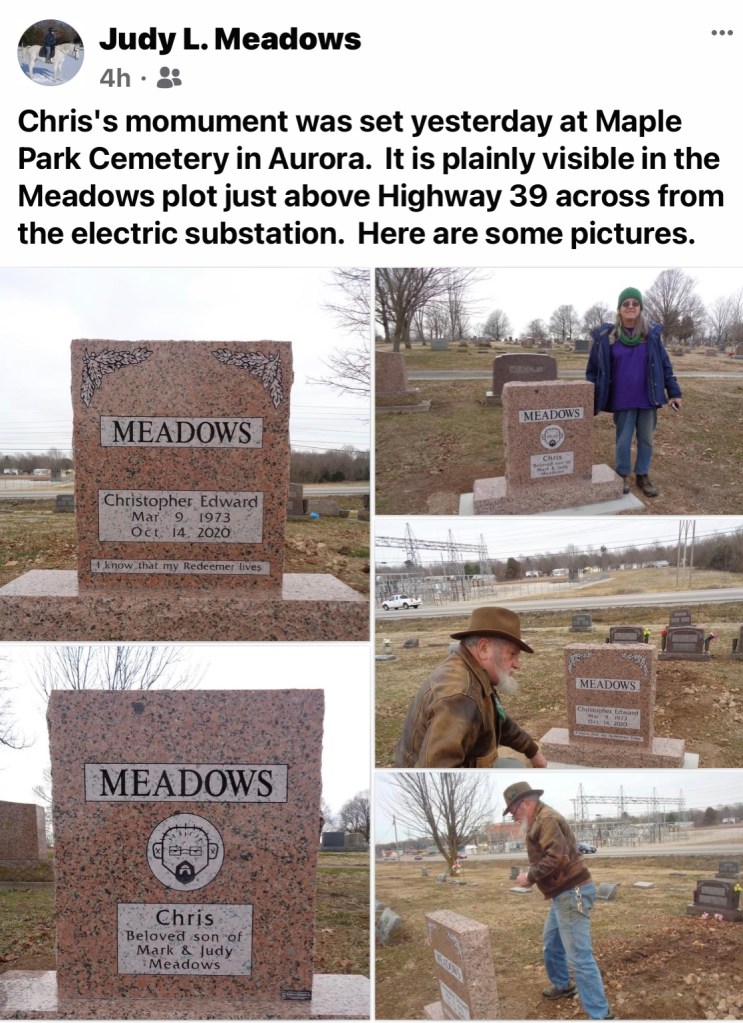
 teleread.org
“This is Chris. How can I make your day better?” I remember hearing him say that so many times when we worked at the same call center together. That was Chris and he meant exactly that. How could he make your day better was his goal. I will always remember him, knowing him made my life better.
LikeLike
I always enjoyed Chris’s ‘Space station Liberty’ podcast, and looked it up recently, as 2007 was the last time i had tuned in to it. I was shocked to hear of his passing. He had a number of great interviews with veteran voice actors, and I am grateful for this contribution that he gave to the world. Thank you Chris!
LikeLike