
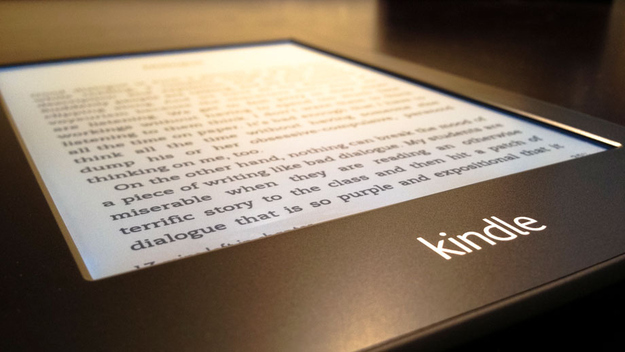
On her blog Tech Meets Books, Karyn Little has noticed how many coloring books are available for the Kobo e-reader, and leaps from that to wondering whether Kobo is striving toward releasing a color e-ink reading device. Is Kobo hoping to have color e-ink appear on its reader screens? She makes that guess, but doesn’t actually provide any supporting evidence in the form of statements from people associated with Kobo that they’re interested in it.
Instead, she cites a two-year-old article by Rafi Letzter noting that color e-ink is difficult, and a year-and-a-half-old article from Gizmodo about a new form of color e-ink that’s only in signage so far. (We covered that same e-ink tech when it came out, and more recently looked at its latest evolution—while at the same time posing the question whether anyone would ever use it.)
Then she covers a piece from The eBook Reader in January wondering whether e-ink screens have “reached their technological peak,” and leaves it at that—without putting a whole lot of further thought into it. As it happens, I have some further thought to put.
First of all—so what if e-readers got color screens? That wouldn’t automatically mean they’d be compatible with coloring e-books. They’d need some kind of software upgrade to let people fill in colors on the pages of those books with those readers. Heck, you could already do that on color LCD tablets; but has Kobo upgraded its tablet app to work with those coloring books?
My personal guess for why coloring books exist for e-readers is to allow people to photocopy and enlarge the page as it appears on the e-reader, or just outright print it out if it doesn’t have DRM on it, to create coloring sheets using regular printer paper. Or maybe they’re just meant as a novelty? Who knows what’s in the mind of people when they put e-books like that up for sale?
But on to e-ink technological advances. Yes, there have been quite a few of those in recent months—the color tech mentioned above, and graphene tech that could theoretically cut the cost of ordinary e-ink screens considerably—but e-ink reader screens haven’t advanced appreciably for at least a couple of years. They got to be good enough, and then they stopped. Why? Well, that was about the time color tablets finally hit it big, as the iPad launched and Android matured. And tablets can read e-books, too.
But more importantly, tablets (and smartphones) also brought with them the ability to play audio and high-definition video through these portable devices. Portable, inexpensive devices. And, in just the last year, portable devices from Amazon that are $30 cheaper than the cheapest e-ink reader it offers. While, at the same time, Amazon has been betting big in digital music services, audiobooks, and streaming video. It’s even producing its own shows, such as the award-winning Transparent and the alternate-history drama The Man in the High Castle.
Just today, both Recode and Business Insider noted that, while Amazon’s downstream bandwidth usage during prime-time is still a distant third place behind Netflix and YouTube, it has more than doubled over what it was a year ago, from 1.97% to 4.26% of total prime-time Internet usage. This puts Amazon ahead of both iTunes and Hulu, whereas both Netflix and YouTube have barely added a percent or so to their own scores in the last year. Perhaps this change is due in part to the influx of $50 Fire tablets that could get people interested in watching Amazon streaming video (especially since, unless you do a little hacking, you can’t put many other streaming video services on Amazon’s proprietary flavor of Android).
When Amazon launched the Kindle, Netflix’s streaming video service was in its earliest days, the iPhone and Android were fairly primitive, and there were few mobile devices that could do much in the way of showing video. The technology wasn’t there yet, nor was a potential audience. But e-books were easy—the technology had already been fully developed over the last few years; all Amazon had to do was add a few gimmicks like always-on wireless. And once Amazon had the perfect e-reader, it built the audience.
But the market has moved on. The iPad brought in agency pricing, but the bigger market change wasn’t as visible—finally showing the tech world what a successful tablet was supposed to look and act like. Just as it had done with smartphones, Android was quick to take the hint. And suddenly the same people who had bought Kindles and gotten into e-reading found something more visual to do with their time—just as readers of paper books had been lured away by movies and TV back in the day.
So, here we are then. Just as with e-books, the current iteration of Kindle is “good enough.” What did Amazon do for its $280 Kindle Oasis? Offloaded the battery into the cover so it could make the whole thing smaller and lighter, changed up the LED lights around the screen, added back physical buttons, and…nothing else. What is Amazon doing for the new generation of its basic $80 Kindle? Making it whiter, lighter, and Bluetoothier, and…nothing else. In both cases, it kept the screens themselves exactly the same as in previous models. The screens that are the most expensive part of the e-reading device.
If Amazon were to adapt new screen tech to the Kindles, it would have to spend a lot of R&D money to adapt it. R&D money that would have to go into the price of the new devices in order to make back that cost. But people just aren’t buying e-ink readers in the numbers they once were—which means those prices would have to leap considerably based on how many they could expect to sell, which means they could expect to sell even fewer. The current Kindle is good enough, so it’s much more cost-effective just to keep rearranging the deck chairs while the Titanic goes down.
What’s more, Amazon doesn’t want to undercut its own tablet sales now, because the tablets are used to consume that audiovisual media, which costs a lot more to make or license than nothing-but-words e-books. Besides, Amazon already has the lock on e-books now. It doesn’t need to make e-ink readers better; it can rest on its laurels. Unfortunately, that means nobody else has a great deal of incentive to make a better e-ink reader either, because even if they made the best one in the world, it couldn’t lure away consumers who’re already locked into Kindle because of the huge library of Kindle e-books they already have. So they’d have the same problem Amazon would in how to recoup R&D costs, except they’d have it several times worse.
At this point, I’d be surprised if e-ink readers’ screens ever saw a major advance again. So, there won’t be nifty new graphene tech, nor will there be color screen tech—as much as I’d love to see the advent of a cheaper e-ink reader stemming from better e-ink technology. People aren’t buying them in numbers sufficient to support that degree of substantial improvement anymore. The Statista stats I’ve cited before show a long slow tapering-off of e-ink reader buyers, and it doesn’t seem likely anything is going to make them start selling in 2011’s numbers again.
Of course, I could still be pleasantly surprised by Amazon rolling out a new model incorporating some nifty new advance in e-ink tech, but I’m not sure I’d put money on it. Where Amazon is now, it’s probably happier promoting the $50 Fire for its multimedia use while it milks e-ink readers for whatever money it can still get out of them until the demand for them entirely evaporates.
 teleread.org
The one thing which is constant in any market is change and that applies to companies as well as markets.
The reason that folks use e-ink readers is that they’re superior to backlit screens — be they LCD or AMOLED — for eye-ease and reading outdoors and that advantage will never go away. So what *might* be on the horizon?? E-ink stepping onto backlit-screen territory with color?? Maybe but that’s playing the backlit game and NOT playing to e-ink strength.
What IS to e-ink’s advantage is *flexible* screen tech and — ultimately — a large screen which can fold into a small package. It’s unbreakable, it’s waterproof and it’s portable. That’s enough to keep e-ink in the game for quite some time.
The problem with extrapolating into the future based upon what’s happening today — Amazon flitring with backlit tablets while e-ink sits home and cries — is that you lose sight of what will, inevitably, change. Fact is, Amazon is all about change — at least so far — but if they’re not, there are plenty of others who *will* change the world.
LikeLike
LCD is bad for reading outdoors. Refresh speed and colour are fairly irrelevant for reading. Readers of multi-column PDFs just need slightly bigger than 6 inch screen
LikeLike