
When I first started writing for TeleRead, it was all about ebooks. They were still a new thing. They needed their own platform. Over the years, TeleRead has evolved to cover other kinds of stories, targeting authors, educators and other tech users with a mix of news and how-tos.
This past year, our esteemed editor David Rothman has called for a return to the ‘ebooks only’ focus, in part to try and improve the site’s SEO and other techie specs. But as a contributor, I’ve really struggled with this change. I’ve found that as people shift their reading format to blogs, RSS feeds, social media and other platforms—and as their device use shifts to tablets, phones and other multi-purpose devices—it’s harder than it used to be to tell what is an ‘ebook story’ and what is not.
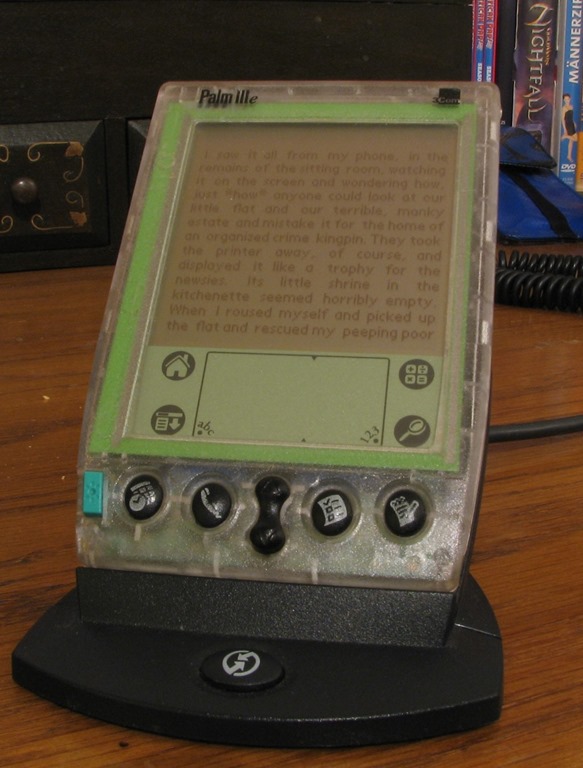
When I started writing for TeleRead, there was one place to buy ebooks, and it wasn’t Amazon. Fictionwise ruled the day, people read on Palm PDA devices or very bulky back-lit bricks like the late eBookwise, which was a slab that weighed more than my current laptop does. There was no such thing as a Kindle. The Sony was just gaining popularity amongst a very niche market, and it cost over $300.
Things are, needless to say, very different now. Many readers are now writers too. And many others, like my Beloved, read thousands of words a week, none of it in book form. Paper books still have a place in our world (I buy craft books for myself, and kids books for the little ones) and have made a few tentative stabs at self-publishing. I have no less than eight devices in my home on which I can read a book, and with two exceptions, they all cost less than my first Kindle did. Two of them (the phones) came with data bundles that let us walk out of the store with them without paying a cent.
And that same phone I read on does other magical things. I can purchase physical books on the same device that I use to read digital ones. I can order take-out food—and track its delivery via GPS. The devices I have today are just so much more capable. When I think of something like a travel book—first it was paper, then there were primitive ebook reproductions, and now there is Google Search linked to your phone’s map function. You just type in, say, pizza restaurant, and it shows you which ones are near you, tells you whether they are currently open or not, and offers to narrate driving instructions to you so you can get there. Isn’t that so much more than a book? Can we really make a case and say let’s improve the formatting for an ebook copy of a Lonely Planet guide when the phone can do THIS?
So it’s made it hard for me to stick to the topical constraints of the Google SEO gods. And in they sense, I welcome a return to the more passion-based Teleread of the past. I’m thinking of stories like the one I did about our local library branch deciding to lend out musical instruments. On the surface, that’s not about ebooks—or about books at all, really. But it is, in a way. Our library has heavily invested in an ebook system, and I for one use it heavily. I know others still use paper books, and they do check them out from the branches. But a percentage of the ‘book checking-out flunkie’ tasks have been automated by people like me shifting to digital. So, now that the librarians are freed from spending as much time as they used to be fulfilling that function, how are they spending their time? I do think the musical instrument lending is a very relevant ‘ebook’ story!
So, where does that leave me? Well, I’ll be reallocating some of the time I spent on writing for pay for TeleRead toward writing for pay on my own projects. I’m off for the summer, and facing just a few weeks of day job after that before I’ll be off for much longer with a new baby. So I have some time to spend on my own passion projects, and you can follow me at joannacabot.wordpress.com if you want to keep up to date on those. I’ll be blogging, too—for the new TeleRead when I have something relevant, and for myself, when I want to share something that’s not really ebook-related.
There is a lot of innovation going on out there right now. I want to stay on top of it! Thanks for reading!
Publisher’s note: I’ll very much look forward to reading Joanna’s future contributions to TeleRead.org!
Meanwhile I want to emphasize that one reason for the just-made return to a noncommercial model was that we wanted more freedom for people to write on non-ebook topics—within bounds—without our worrying so much about SEO for Google. So, yes, Joanna will be able to do a K-12 item for us if it’s even remotely related to e-books or something in that general territory. She’s a teacher, after all. We cherish her K-12 expertise, too, not just her passionate advocacy for fellow ebook lovers.
We can’t, however, just write at random on education, underwater basket weaving or tech or whatever. Otherwise we’ll come across as a minor league Atlantic or Ars Technica. A small blog needs a special focus. While we won’t fixate on Google, we need to stay at least a little visible in the search results.
That’s my thinking, anyway. I’d love to hear from TeleRead community members with their own thoughts on this matter. Just how focused do you want us? What topics should we care about most ? The comments area awaits you. – David
 teleread.org
Best of luck on your future endeavors, Joanna!
Can you send me an email? I have a few suggestions which I can’t make in public (I don’t want to let someone cut in.).
LikeLike
Now back to TeleRead Community business. I encourage people to read the publisher’s note at the end of Joanna’s post and share suggestions in regard to topics for us to focus on. Home page traffic, by the way, so far has gone up since the switch to .org.
LikeLike
No articles on underwater basket weaving? I’m heartbroken. Seriously, I look forward to whatever all of you bring our way. Maybe it doesn’t fit, but I’d find an article/discussion on what folks did with their ebook settlement money interesting. Not sure what else, I’ll have to think on it.
LikeLike
@MrsMac: Fits perfectly. Go to it, Community Members! Tell us here what you’re doing with the money. Joanna can write up a summary and add her own thoughts.
LikeLike
Well, I’m using my settlement money for guilt free book shopping for titles from my wish list. I’ll be happy to share the titles if you want, but I don’t want to ruffle feathers as they lean toward conservative reading. 😉
The recap is that I’ve spent roughly 2/3 of my settlement, and spent from $9.99 to $16.99. I’m quite happy to have guilt free money. haha
LikeLike
@MrsMac: Thanks for sharing an overview of what you did with the settlement. What’s more, feel free to mention the specific titles. The deal is that I won’t criticize your choices, and I respectfully request other community members to refrain from doing so. I’m unabashedly progressive and express my opinions on TeleRead in a relevant tech-related way. At the same time, I want reasonable people of all political opinions to feel comfortable here even if they disagree. Remember, I myself was a guest contributor years ago to National Review – without having to change my politics (NR reminder call for an Electronic Peace Corps). Bill Buckley I differed on most things political, but he actually was a lot more open to my national digital library vision than were my fellow liberals. Here’s to pragmatism, tolerance and civility ahead of ideology! David
P.S. I’d still love to hear from others as to how they’re spending their settlement money.
LikeLike
There are just two things to focus on: 1) understanding who your audience is and what their needs are and 2) understanding what you want to say to that audience in pursuit of meeting their needs. Google and others who seek to piggyback on your work will have to catch up with that and adapt.
This is just a longwinded way of saying ” be true to yourself.”
LikeLike
Hokay, here goes. 😉 This is what I’ve purchased to date, and I’m still debating over several selections (mostly non-fiction and the list is at the end). I’d love to read more books along the lines of what Michael Tougias writes, but haven’t found any that interested me. The only books on this list that I would have purchased *without* the settlement are the last three. I’m cheap. 😉
~Unger’s Bible Dictionary: 16.99
~Unger’s Bible Handbook: 16.19
~Crisis of Character: 13.99 (preorder by Gary J. Byrne)
~Rescue of the Bounty (Tougias): 11.99
~First Family Detail (Kessler): 11.99
~The Day the President Was Shot (Reagan kid version by O’Reilly): 9.99
~A Woman’s Guide to Reading the Bible in a Year: 5.89
~NAS Bible: 2.99
~George Washington’s Secret Six: Spy Ring (Kilmeade): 1.99
Still on my wish list and fighting for my remaining credit:
~Bill O’Reilly’s Legends and Lies: The Real West
~Written Off: A Mysterious Detective Mystery by E. J. Copperman (good author, but pricey for a mystery)
~We the People: The Modern-Day Figures Who Have Reshaped and Affirmed the Founding Fathers’ Vision of America by Juan Williams
~The Triumph of William McKinley: Why the Election of 1896 Still Matters by Karl Rove
~So Close to Home: A True Story of an American Family’s Fight for Survival During World War II by Michael J. Tougias, Alison O’Leary
~Eyes Pried Open: Rookie FBI Agent by Vincent Sellers
I too would love to know what others have done with their settlement money.
LikeLike
@Mrs. Mac: Thanks! I spent the money on a heater, but among my recent book purchases are King Leopold’s Ghost and Close to Shore: The Terrifying Shark Attacks of 1916. David
LikeLike