By Ficbot
With Amazon, and now Barnes & Noble, coming out with major new releases, it looks like competition is heating up at last in the emerging e-reader marketplace.
Like most e-book fans, I read the news with interest. Following the not unexpected but still disappointing news that neither the international Kindle nor the B&N Nook would be made available to Canadians soon, I started wondering about people who shop based on features and people who shop based on brand loyalty.
I always thought I was a tough customer who researched every purchase carefully and shopped on the features. But as I read the details about these spiffy new products—available to everyone but YOU, Ficbot, you CANADIAN, you—I looked at my Sony in a new light.
Canada love from Sony
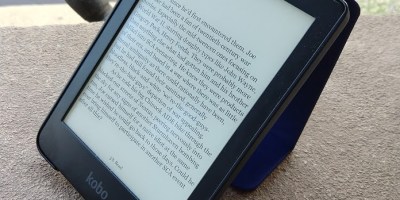
Sony loves Canada. They want me to buy their readers. I got mine in a store, even! Retail! From a clerk who even was properly trained and knew his stuff! Sony has given me the Mac software. They have given me the Google Books access.
“The next move in the ereader space belongs to Amazon. That sound you heard was the air being let out of the Kindle’s tires. Amazon is now forced with the decision to be pragmatic and support the open .epub format or risk being locked out of the market.” – Allen Weiner, Gartner analyst, reacting to Nook announcement.
Reminder: DRMed ePub still won’t be an open, nonproprietary standard. Alas, big publishers are still insisting on DRM.
Will you be able to buy e-book files from B&N and read them on your Sony Reader, just as your friends can read them on their B&N Nook e-readers?
This depends on Sony and the others updating their Adobe-supplied firmware for their dedicated e-readers. So there are gotcha indeed (yes, I’ve revised this post). Let’s hope that other companies will include the new DRM for compatibility’s sake—even though the best solution would be no DRM. See a helpful explanation from Adobe’s Jim Lester.
On the social DRM front…
Meanwhile another question arises. Could Adobe and B&N also be moving social DRM in time? With help from a reader, I noticed the following in an Adobe release:
I’m a Kindle 2 owner myself and have talked up the K2’s good points and shared tips with fellow users.
Even so, as long as Amazon taints bestsellers and so many other books with proprietary DRM, I’ll consider the Kindle a closed system—at least in ways that count for many readers.
Open systems, moreover, don’t include the capability for the hardware provider to zap books—even 1984! Nor do open systems let publishers prevent disabled people from using text to speech.
Looking beyond the machine, if the Kindle is so open, how come my publisher can’t even get a DRMed edition of my novel removed from Amazon.com. She couldn’t offer The Solomon Scandals at the Mobipocket Store without tolerating a DRMed version of my novel at Amazon.com in addition to the nonDRMed file. Trouble is, the DRMed edition remained at Amazon.com even when we withdrew from the Mobi store. Is that really openness?
Dave “Evil Genius” Slusher is a good guy, but I’d very respectfully disagree with his recent thoughts on the Kindle’s so-called openness. And the same for you, Paul.
Related: Mitch Ratcliffe’s comments.
Image credit: Creative Commons photo from Quinn Anya Domrowski.
By Paul Biba
Got this email that I thought I should share with you:
Hi,
I think TeleRead missed this announcement at the Frankfurt Book Fair:
The German text is about the planned improvements of the German eBook portal libreka!, which is the official eBook shop of the Börsenverein des Deutschen Buchhandels (federation of German publishers and book stores). The interesting part for non-Germans is the announcement of the release of a libreka! iPhone app in the beginning of November. With this app it will be possible to buy and read the eBooks sold at libreka!—which are EPUB with Adobe DRM. So this will be the first official iPhone eBook reader for EPUB with Adobe DRM.
Best regards,
Tobias Steinke
OpenInkpot, a linux-based replacement for the proprietary software in e-book readers, will soon sport a spiffy graphical user interface and improved tabletlike architecture. Take a look at some preview documentation.
The reading software includes FBReader, which can handle nonDRMed ePub, unencrypted Mobipocket HTML, TXT, and a bunch of other formats.
Of special interest, to me, is that you can choose to boldface all the text—rather handy, given the less than stellar contrast of the current generation of E Ink displays. The text will stand out better against the not-quite-white backgrounds of the screens.
This is one reason why I’m so opposed to DRM. As good as OpenInkpot seems to be if you go by the feature set, you can’t use it to read “protected” bestsellers.
Here’s a list of supported and nonsupported machines. Alas, at least for now, OpenInkpot isn’t usable on such popular machines as the Cybook Gen3, the Sony Reader 505, the iRex iLiad or, due to hardware limits, the Kindle. But in some cases, you’re in luck if you own a Hanlin or Astak machines or certain other brands, so click on the link.
(Via Felix Torres.)
![]()
How good is the Kindle 2’s text to speech feature?
No, the TTS isn’t the equal of a human voice, especially one as memorable as that of Jim Dale, the Harry Potter narrator shown with actress Glenn Close.
Many have complained of the lack of inflection. Some have cited this as one reason for Amazon and others not to disable TTS to satisfy the whims of publishers. I myself think that playing text is fair use, just as large purple characters or a certain typeface would be.
In all honesty, however, the K2’s speech synthesis is far, far better than many other TTS systems. I can finally understand the speech with hardly any difficulty. And I suspect that the TTS is going to improve considerably in the future—a bit of a scary prospect since this could intensify opposition by certain publishers.
The Los Angeles Public Library won’t buy e-books in a format for Adobe Digital Editions until ADE software supports text to speech, according to Library Journal.
OverDrive, supplying ADE-format books for the library, hopes that a solution can be worked out, but if not, it will be “working on other avenues” beyond Adobe.
The controversy has all kind of ramifications for disabled and nondisabled users alike. I applaud the Los Angeles library and OverDrive for their concern and hope that it sends a strong message to publishers, especially those who’ve used the Kindle’s DRM to switch off synthesized speech for many best-sellers. Should Amazon go after the library e-book market, libraries should not only insist on the use of the ePub standard but also on TTS capabilities for all Amazon-supplied books.
The Kindle 2 and global models, along with the DX, all have manuals readable in PDF on your desktop or laptop monitor.
Go here for download information on the manuals in all formats. Quick Start Guides are there, too.
If you don’t own a Kindle but are considering one, the guides might be helpful reading to spare you rude surprises later on. May they someday mention ePub! And also be able to say eventually that only older books are DRMed.
For the original Kindle, here are PDF links for Kindle User’s Guide and About Your Kindle Manual.
The CC-licensed Kindle photo above, in case you’re curious, shows ed-tech specialist Aileen McHale, teacher of a recent University of Scranton workshop called Curl Up with Your Kindle. I’m tired of using Amazon store shots. Got a photo of yourself or a family member using a Kindle or other e-reader? Send it in with the email subject line of MyEGizmoPhoto and permission to use it without any copyright restrictions, and we may run it if the context is right.
On three separate matters:
You don’t own your books for real when you buy ‘em with DRM, as Amazon’s 1984 recall showed us.
When will the Federal Trade Commission, the bureaucracy housed in the building to the left, crack down on that—in a truly meaningful way?
Just why isn’t the Amazon site full of big, conspicuous reminders mandated by the FTC?
So you can bet I was more than a little baffled when the FTC announced hefty fines for bloggers who didn’t play by a newly announced set of rules about free products (PDF alert), including review copies of books. Bottom line: You’d better disclose if you review a book and keep a copy, even an e-book that cost the author virtually $0 to email you. Isn’t this a little inconsistent, given the FTC’s laxity on DRM at Amazon.com and elsewhere, despite a recent hearing?
By Paul Biba
There are
a whole series of postings on the Adobe Digital Editions forums about people being unable to download protected files to their Sony Readers. Here is one of them:
I’m having the exact same problem. A week ago I downloaded 5 EPUBs with DRM from San Francisco public library. They transfered to the PRS505 and read fine. Today I downloaded 2 more books. They open fine in the ADE software. They will not open in the Sony Library (”This computer is not authorized to read these files”). They do not open on the Sony Reader (”Protected Page”).
It used to work, now it doesn’t. The reader and ADE are both authorized.
I have trouble tickets in with Sony and Adobe but I’m not optimistic.
This is incredibly frustrating. ADE is the buggiest piece of software I’ve encountered in a long time, and we’re held hostage to it because of DRM.
Is anyone else having similar problems? Thanks to Terrance Teoh for the link.
By Felix Torres
Editor’s note: Who’s downloading e-books illegally, and how much are publishers really losing? Is every illegal download in fact a missed sale?
Randall Stoss, author of a “Napsterization” piece in the New York Times, should check out the post below by Felix Torres, a TeleRead community member. It’s a slightly edited version of comments Felix wrote here earlier. Publishers, too, should read him. This tutorial happened accidentally, but that’s what it is, in effect, while the headline is mine.
I personally am in favor of legal action against major pirates, which Stross presumably would want at the very least. But DRMing of “sold” titles—and other consumer-hostile atrocities, including delayed releases of e-books—will just turn law-abiding readers into piracy fans. Why didn’t Stross mention the heavy damage the publishers are inflicting on themselves? Wouldn’t saner distribution of e-books be more cost-effective than just a flood of lawsuits? And now here’s Felix’s post. Also see Chris Meadows’ analysis of the Stross column. – D.R.
By Felix Torres
When it comes to book “piracy,” it is pretty clear there are kinds of players.
Category One: Hoarders
Hoarders grab free stuff just because it is free. More often than not, they will never actually consume what they troll for.
Even if they read a fraction of what they “pirate,” they would never actually buy the stuff if it were legally available. Hoarders are a nuisance at most—the online equivalent of shoplifters.
Amazon CEO Jeff Bezos hates people with vision problems. Wait. Actually he does not, but as shown by the font-size and text-to-speech issues, his people at Amazon have been less than stellar in helping them.
The type on Kindles just is not large enough. Jeff’s machines won’t even let you bold all the words in a book—a failing shared by most other e-reading devices. The low contract of E Ink, between text and background, just worsens matters.
For now, however, at least if you’re sufficiently technical and own a 2 rather than an original Kindle, a partial solution exists for the size issue—a large-print font hack for the Kindle 2. Big thanks to TeleRead community member Felix Torres for pointing people to the related instructions.
You might also be in luck if you own a Kindle DX.
The experimental hacks for both machines provide a little help, too, in the bold area.
But why does Amazon make its customers go to all this trouble; especially, how about the nontechnical? Next time Amazon gives us some PR spiel about being a Good Guy company, just ask about its callous treatment of visually impaired. Funny. I thought Amazon and other dedicated device makers wanted to grow the market for e-reading. Can’t visually impaired people, too, be customers? (An aside: The Amazon-related rants are mine, not Felix’s.)
Engadget’s Michael Gartenberg and Techdirt’s Michael Masnick square off in opposing columns about the merits or lack thereof of Digital Rights Management (DRM).
Gartenberg feels that DRM has been demonized unfairly, and that it enables new business models that could not exist without it.
Take subscription services for example. Sure, I’d love a service that would allow me to download unlimited content in high bitrate MP3 format for a reasonable fee every month. Except economics and greed will never let that happen (although I suspect we’d see a lot users sign up for about 30-60 days).
Gartenberg does not address what happens when that DRM-locked subscription service goes out of business, though he does admit that DRM is easily broken.
Yes, I know most DRM solutions can and will be circumvented. If there’s a lock on the door, someone is always going to try to find the key and usually they will. It’s not about that. Folks that are looking to avoid paying for stuff will usually find a way. I’m talking about folks who are willing and looking to legally acquire content.
New York Times reporter Brad Stone’s take on sales figures for the e-book version of The Lost Symbol—versus the numbers for the p-book—inspired lots and lots of skepticism from E boosters.
And I’m still waiting for him to write on social DRM and certain nuances of e-book standards that he and the Times have yet to explore, despite some progress in a recent article.
But Stone is right on the mark in highlighting another Kindle issue. And that’s the ticklish little matter of opening up the Kindle to third-party developers. Look at all the apps for the iPhone, such as the one shown here for Facebook.
Even with the the slow refresh rate of the Kindle’s E Ink, notes Stone, “there are still some interesting possibilities. Companies like Facebook or Goodreaders could add social features to the Kindle; game developers like Zynga could create nongraphics-intensive games like poker or chess for the device. There could also be educational games, or programs that take advantage of that rarely used keyboard and Kindle’s ‘experimental’ Web browser.”
Macmillan’s CEO, John Sargent, worries about free content diminishing interest in the paid variety—and about piracy.
“We are at the stage of the music industry just before file-sharing,” PW quotes him about the book-publishing industry.
He says pirates are carrying 90 percent of Macmillan’s front list titles.
Uh, John, might frustration with DRM have a little to do with it? Just shows you can’t stop the bad guys with “protection.” But along the way you will stop lots and lots of law-abiding people from buying e-books.
Related: MediaBistro item. Sargent debated Chris Anderson of Wired over the usefulness of “free.”
By Paul Biba
Good news. At least some Microsoft Press e-books will appear without DRM. And in ePub, too, maybe? Just speculation.
Microsoft and O’Reilly Media have entered into a joint arrangement to distribute, co-publish, develop content and manage the expansion of Microsoft Press. This is for the Northern American market and will involve paper as well as electronic books.
From our point of view, however, the big news and possible news would be on the digital end. O’Reilly is solidly committed to the ePub format standard. Will Microsoft Press use ePub on some titles, at least? And could a future version of Microsoft Reader boast ePub capabilities? ePub is a kissin’ cousin of Microsoft’s LIT format.
Here are a few quotes from the press release: