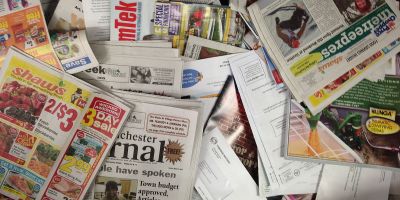
This morning, a friend linked to an Associated Press article, and tweeted, "we feel that the time has come for the cat to wear a bell, and are confident in swift enbellment of the cat." And looking at the article, I have to agree.
The article in question covers the leaders of the Associated Press and News Corp making a lot of noise at the World Media Summit about how the time has come for news services to stand up to news aggregators and search engines and demand payment.
AP chief exec Tom Curley said that more people were using websites such as Wikipedia and Facebook to catch breaking news, rather than traditional news sites, and that services such as AP and News Corp need to act now to regain control of the news content they provide.
That’s right, Tom! Take back the web! Why, how dare those search engines and news aggregators and other such sites have the temerity to publicize your content for you? Let’s not forget, this is the organization that once claimed they would charge bloggers $675 a word for the “fair use” of excerpts longer than ten words, and then retracted the claim but refused to be specific about any new guidelines.
I really like the paragraph further down the page where it talks about the AP planning to set up a plagiarism-detection system to “help boost revenue for the not-for-profit news cooperative”. Did they actually write that with a straight face? If they’re not-for-profit, shouldn’t they be concerned about things other than their revenues?
(Well, all right, to be fair, the quote also mentions the AP’s member newspapers. Still, it looks funny on first read-through.)
You know what Google should do? Google should simply remove the AP and its member papers from its services entirely. No Google News, no Google Blogs if the papers host blogs, no Google search engine indexing at all. Let the AP be entirely defunct as far as Google is concerned.
Then the AP could just find out what would happen to its precious revenue.
Edit: Edited to remove direct link to and quoting in excess of ten words from the AP article. Just in case.
Since Google took on its first 100,000 public beta testers, the Internet has been awash in a wave of Google Wave interest. Some people have even tried to buy or sell Google Wave preview accounts on eBay!
Gina Trapani at Lifehacker has an in-depth first look at Google Wave that examines its various features. Wave comes off as a fancier version of EtherPad (which I covered here), incorporating instant messaging, e-mail, and a number of other features.
Robert Scoble thinks Google Wave is overhyped and will actually lead to “unproductivity.” However, Mark Milian on the Los Angeles Times Blog thinks that Google Wave has the potential to “transform journalism” into a more collaborative process.
You may notice that double bylines aren’t very common. That’s because trying to co-author a news story stinks.
The process usually involves one reporter talking to and researching a few things and another following a different set of sources and finally combining their findings toward the end. This can result in a mess of incompatible and unrelated research that gets either thrown out or somewhat-awkwardly wiggled in.
I find it interesting how much this echoes what I have discovered in writing fiction with EtherPad.
Image: From Wikipedia.
By Paul Biba
Amazon Kindle Review has a compilation of reviews of newspapers that the Kindle can display.
For the Kindle, the New York Times is the best-selling newspaper. But, in 150 customer reviews, the august Times gets an average rating of just three of five stars. Some people want the $13.95 monthly subscription price slashed. Others gripe that the Kindle edition does not include all the articles.
If you own a Kindle and are a newspaper reader, you might want to go to the Kindle Review site and check the Times review and the others. For now, here is an excerpt from the end of the compilation:
New York Times reporter Brad Stone’s take on sales figures for the e-book version of The Lost Symbol—versus the numbers for the p-book—inspired lots and lots of skepticism from E boosters.
And I’m still waiting for him to write on social DRM and certain nuances of e-book standards that he and the Times have yet to explore, despite some progress in a recent article.
But Stone is right on the mark in highlighting another Kindle issue. And that’s the ticklish little matter of opening up the Kindle to third-party developers. Look at all the apps for the iPhone, such as the one shown here for Facebook.
Even with the the slow refresh rate of the Kindle’s E Ink, notes Stone, “there are still some interesting possibilities. Companies like Facebook or Goodreaders could add social features to the Kindle; game developers like Zynga could create nongraphics-intensive games like poker or chess for the device. There could also be educational games, or programs that take advantage of that rarely used keyboard and Kindle’s ‘experimental’ Web browser.”
By Stephen Windwalker, editor of The Kindle Nation
When an experienced newsman like The Kindle Chronicles podcaster Len Edgerly interviews an experienced newsman like Timesman Brad Stone (photo) on a newsy topic like the Kindle, there’s bound to be some news made.
Here are a few things I noticed as I listened to this week’s podcast:
On the Nieman Reports, Michael Skoler sums up the root of the problems that traditional media are now facing. Others have said similar things before, but this essay says them so well that it is very much worth reading.
And what is that root? The way the culture has changed since the advent of the Internet. Most news media are still trying to be one-way, top-down information providers in a fully-interactive world. Skoler writes:
Today, people expect to share information, not be fed it. They expect to be listened to when they have knowledge and raise questions. They want news that connects with their lives and interests. They want control over their information. And they want connection—they give their trust to those they engage with—people who talk with them, listen and maintain a relationship.
By Paul Biba
This is from B.I.T.online – Zeitschrift für Bibliothek, Information und Technologie:
Hamburg – The Austrian National Library in Vienna is a pioneering force in Europe for the digitisation of books, newspapers and other materials.
By order and at the expense of Austrian foundation Socrates, the Hamburg based docWORKS specialist CCS Content Conversion Specialists has digitised the “Wiener Zeitung” (Viennese Newspaper) with all its supplements: “Wiener Abendpost” (Vienna Evening Mail), “Amtsblatt” (Gazette) and “Zentralanzeiger für Handel und Gewerbe” (Official Trade and Commerce Bulletin). The Wiener Zeitung is part of the stock of the Austrian National Library. The project covers the volumes from 1909 to 1923 and has a total of 100.000 pages. The Wiener Zeitung is the oldest Austrian newspaper that is still being published today, having started in 1703 as the “Wienerisches Diarium” (Viennese Daily). Its Gothic type represents a tough challenge for OCR (optical character recognition). The digitising process includes automatic analysis of the papers’ layout (captions, columns etc) – this will later enable searches to be performed within an article.
(more…)
Rupert Murdoch marches on in his crusade to charge for content. Murdoch has lately announced that the Blackberry and iPhone Wall Street Journal readers, currently free, will soon begin charging for access. The fee is to be $2 per week for those who do not subscribe to the Journal at all, $1 per week for print or on-line subscribers, and free to those who subscribe to both the print and on-line editions.
It is tempting to shake my head sadly at Murdoch’s apparent drive to strip away all relevance from his paper. But on the other hand, the Journal is one of few papers that has been successful at charging for web content—and the Journal’s target audience will generally have extra money to burn. So who knows?
And Murdoch may not stop with this paper. At the event where he announced the Journal charges, he “added that the company was mulling options such as subscriptions and pay-per-view for Hulu”.
Sheesh.
By Paul Biba
That wonderful blog, Bookofjoe, sent me a link to Fast Flip. This is a really neat way to look at a huge volume of pages. So far it’s been fun to try out, but I’m not sure that I prefer it to RSS feeds. We’ll just have to play with it and see. Here’s what the Google Blog says:
One problem with reading news online today is that browsing can be really slow. A media-rich page loads dozens of files and can take as much as 10 seconds to load over broadband, which can be frustrating. What we need instead is a way to flip through articles really fast without unnatural delays, just as we can in print. The flow should feel seamless and let you rapidly flip forward to the content you like, without the constant wait for things to load. Imagine taking 10 seconds to turn the page of a print magazine!
Today we’re adding a new experiment to Google Labs: Google Fast Flip, accessible at fastflip.googlelabs.com. Fast Flip is a new reading experience that combines the best elements of print and online articles. Like a print magazine, Fast Flip lets you browse sequentially through bundles of recent news, headlines and popular topics, as well as feeds from individual top publishers. As the name suggests, flipping through content is very fast, so you can quickly look through a lot of pages until you find something interesting. At the same time, we provide aggregation and search over many top newspapers and magazines, and the ability to share content with your friends and community. Fast Flip also personalizes the experience for you, by taking cues from selections you make to show you more content from sources, topics and journalists that you seem to like. In short, you get fast browsing, natural magazine-style navigation, recommendations from friends and other members of the community and a selection of content that is serendipitous and personalized.
The corrupt Washington Telegram in The Solomon Scandals is, mercifully, fictitious. But in real life, some newspapers are selling out in a different way—by diverting money from their newsrooms to jack up profits and please Wall Street. So much for the Net as the cause of all evil.
Here’s an excerpt from The Withering Watchdog: What really happened to investigative reporting in America, a PBS series:
“Exposé analyzed the financial records of the five most profitable publicly-traded newspaper companies in America. Not only was each profitable during last year’s apocalyptic financial collapse—averaging nearly $294 million in profits each—but when adjusted for inflation, the profits these media giants made in 2008 were higher than their 20-year average profits.
“In other words, even in the worst economy since the Great Depression, these top media companies made more profit than they had on average for the past two decades.”
To answer the inevitable question, the five most profitable newspaper companies traded publicly are Gannett, McClatchy, the New York Time Company, Lee and Scripps, according to Laura Frank, a former reporter with the now-defunct Rocky Mountain News, who wrote the PBS article.
Question: What if the newspapers had invested in a smoother journalistic transition to the Net? Imagine all the jobs they could have saved!
Related: Google’s proposal to collect fees for newspapers—and some understandable skepticism. Also see Techmeme roundup.
By Paul Biba
More and more newspaper digitization projects are appearing around the world. From the Canadian Heritage site:
[The Canadian government] announced funding for Athabasca University’s “Connecting Canadians: Canada’s Multicultural Newspapers” project.
This project will digitize and deploy to the Web up to 20 multicultural newspapers on an open-access basis. In addition to making multicultural newspapers freely available to anyone on the Internet, it will include audio and video streaming of selected articles and teaching and learning activities that will be of interest to students, teachers, and researchers. A key driver of this project is the use of technology to facilitate access to the content, which will be PDA- or mobile-friendly.
Randy Cassingham, the compiler of the weekly “This is True” humorous-news e-mail newsletter, has posted an entry in his blog nominally about "The Future of Newspapers". Despite the title, the post is actually more about Randy’s past in on-line-news discussion forums, and how many of the other forum participants were not as perceptive as Randy when it came to the on-line future of news. Randy also calls out the news industry for pandering to “hysteria” over such events as Janet Jackson’s infamous Superbowl “wardrobe malfunction”.
However, there is an interesting discussion going on in the comments as readers, too, express their dissatisfaction with the state of the news reporting industry today. Rampant bias and news stories written more to entertain than inform are the targets of commenters’ ire.
The newspaper industry should pay attention to these comments. If they seriously expect people to pay for the news stories they provide, they should get their houses in order and provide news that actually is worth paying for. There will always be plenty of free competition.
Washington columnist Robert Novak has died. No e-book or Net angle exists here—beyond Novak’s importance to the old media elite—but I can’t help writing about him.
Novak, ever the curmudgeon, loved the nickname that a Newsweek reporter gave him—“The Prince of Darkness,” which he said reflected his pessimism about civilization. Others interpreted it differently, saying Novak pandered to the powerful and helped destroy Valerie Plame’s usefulness as a CIA agent. Will we soon learn of an exclusive Novak interview with Lucifer?
Facetiously or not, Novak once griped that that the sight of homeless people on TV ruined his Thanksgiving dinners. Read the full details via the New York Times, Washington Post and—Novak would probably hate this link—Google News. Wikipedia has already updated the Novak entry to include news of the death.
(Moved down below the Google item—since this is a bit offtopic.)
Has the Kindle craze actually reached the point where AP is running a piece on e-book fans who DON’T use the K machine or other dedicated readers? Indeed.
Never mind that people have read Project Gutenberg books off full-sized PCs for decades. Or that the headline uses the Kindle-centric term of “Kindleless.”
Psst! That’s one word. I wonder how many other words the AP copyright cops will let me quote before I’m to pay. At one point the freebie limit was no more than four. Still true?
Mini-briefing for digital natives: “Extra, extra” refers to the extra editions that print newspaper used to put out when hot news broke. Some may still do.
(Via Eoin Purcell.)
At least 16 e-readers now support or will support ePub via Adobe Digital editions, and Adobe has compiled a nice, handy list.
Besides Sony (“four devices”), the vendors include Astak (three), BeBook (two), Bookeen (at least one—see Christine’s comment), COOL-ER (one—shown here in various colors), Elonex (one), Hanlin (two), Irex (one) and Neolux (one).
On top of the Sony’s eBook Store’s forthcoming adoption of ePub—not to mention the Sony Reader’s ability to read ePub in the first place—this is good news for standards white hats.
The only fly in the ointment is that Adobe-DRMed ePub is really a proprietary format in effect. As noted separately, I’m more than a little grouchy at the New York Times tech section for downplaying this fact. The section is generally stellar, but when it comes to e-book standards coverage, the NYT is about on par with Judy Miller reporting on “weapons of mass destruction.”
(Via Adobe’s Nick Bogaty, as well as Electric Book Works.)
King Kaufman, whose usual venue is covering sports for Salon Magazine, weighs in with a thoughtful blog post that discusses the perceived “evils” of stock photography and compares them to the ongoing controversy regarding paid versus free news content on the web.
The article is about a photographer whose picture of a jar of coins ended up on the cover of Time Magazine. When he posted about this achievement in a photography discussion forum, it came out that he only got $30 for it via a stock photography agency. Although the photographer in question was simply pleased to see his work featured on the cover of Time, others pointed out in the discussion that followed that commissioned cover photos could run into the thousands of dollars.
Kaufman quotes several of the stock-photo opponents complaining that multi-billion-dollar companies should not be able to get cover photos so cheaply. One poster opines that if there were no stock photography sites, companies would have to pay fair rates for photos instead of rock-bottom stock prices. Kaufman compares this to the belief that if news providers stopped giving away their content free, people would buy it instead.
But, as Kaufman points out, this fails to take into account the basic principles of supply and demand. There will always be some photographers willing to sell photos more cheaply than others—and there will always be some news sites willing to offer their news for free.
If Time hadn’t found Lam’s stock photo of coins in a jar for $30, or $125, it would have found a similar photo for a similar price. If news consumers can’t get their news online for free from their favorite news organization, they’ll find it for free somewhere else.
It seems to me that a lot of the problem, both in stock photos and on-line papers, is emotional: it doesn’t feel right to people who provide the content that other people should be able to use the content much more cheaply than it is “worth”. But content providers don’t get to decide what their content is worth—at least, not solely. If they charge more than the market will bear, the market will go elsewhere.
I suspect that a number of on-line news sources will end up having to learn this the hard way.